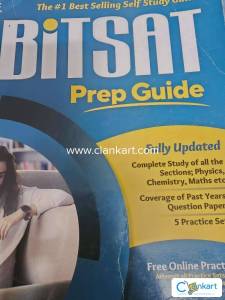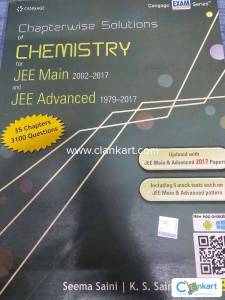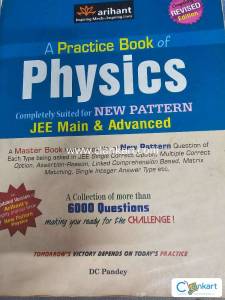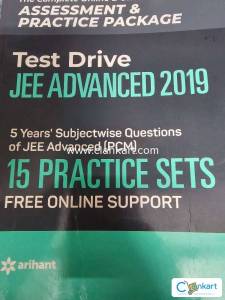
Buy used Books for JEE online in India
Buy Second Hand Books, Used Books Online In India
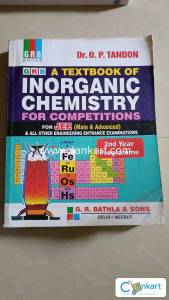
Textbook of Inorganic Chemistry for Competitions Part 2
An advanced-level textbook of inorganic chemistry for the graduate (B.Sc) and postgraduate (M.Sc) students of Indian and foreign universities. This book is a part of four volume series, entitled "A Textbook of Inorganic Chemistry – Volume I, II, III, IV". CONTENTS: Chapter 1. Stereochemistry and Bonding in Main Group Compounds: VSEPR theory, dπ -pπ bonds, Bent rule and energetic of hybridization. Chapter 2. Metal-Ligand Equilibria in Solution: Stepwise and overall formation constants and their interactions, Trends in stepwise constants, Factors affecting stability of metal complexes with reference to the nature of metal ion and ligand, Chelate effect and its thermodynamic origin, Determination of binary formation constants by pH-metry and spectrophotometry. Chapter 3. Reaction Mechanism of Transition Metal Complexes – I: Inert and labile complexes, Mechanisms for ligand replacement reactions, Formation of complexes from aquo ions, Ligand displacement reactions in octahedral complexes- acid hydrolysis, Base hydrolysis, Racemization of tris chelate complexes, Electrophilic attack on ligands. Chapter 4. Reaction Mechanism of Transition Metal Complexes – II: Mechanism of ligand displacement reactions in square planar complexes, The trans effect, Theories of trans effect, Mechanism of electron transfer reactions – types; Outer sphere electron transfer mechanism and inner sphere electron transfer mechanism, Electron exchange. Chapter 5. Isopoly and Heteropoly Acids and Salts: Isopoly and Heteropoly acids and salts of Mo and W: structures of isopoly and heteropoly anions. Chapter 6. Crystal Structures: Structures of some binary and ternary compounds such as fluorite, antifluorite, rutile, antirutile, crystobalite, layer lattices- CdI2, BiI3; ReO3, Mn2O3, corundum, pervoskite, Ilmenite and Calcite. Chapter 7. Metal-Ligand Bonding: Limitation of crystal field theory, Molecular orbital theory, octahedral, tetrahedral or square planar complexes, π-bonding and molecular orbital theory. Chapter 8. Electronic Spectra of Transi
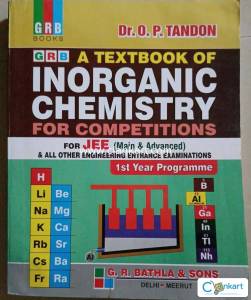
A textbook of Inorganic Chemistry for Competitions Part 1
An advanced-level textbook of inorganic chemistry for the graduate (B.Sc) and postgraduate (M.Sc) students of Indian and foreign universities. This book is a part of four volume series, entitled "A Textbook of Inorganic Chemistry Volume I, II, III, IV". CONTENTS: Chapter 1. Stereochemistry and Bonding in Main Group Compounds: VSEPR theory, d -p bonds, Bent rule and energetic of hybridization. Chapter 2. Metal-Ligand Equilibria in Solution: Stepwise and overall formation constants and their interactions, Trends in stepwise constants, Factors affecting stability of metal complexes with reference to the nature of metal ion and ligand, Chelate effect and its thermodynamic origin, Determination of binary formation constants by pH-metry and spectrophotometry. Chapter 3. Reaction Mechanism of Transition Metal Complexes I: Inert and labile complexes, Mechanisms for ligand replacement reactions, Formation of complexes from aquo ions, Ligand displacement reactions in octahedral complexes- acid hydrolysis, Base hydrolysis, Racemization of tris chelate complexes, Electrophilic attack on ligands. Chapter 4. Reaction Mechanism of Transition Metal Complexes II: Mechanism of ligand displacement reactions in square planar complexes, The trans effect, Theories of trans effect, Mechanism of electron transfer reactions types; Outer sphere electron transfer mechanism and inner sphere electron transfer mechanism, Electron exchange. Chapter 5. Isopoly and Heteropoly Acids and Salts: Isopoly and Heteropoly acids and salts of Mo and W: structures of isopoly and heteropoly anions. Chapter 6. Crystal Structures: Structures of some binary and ternary compounds such as fluorite, antifluorite, rutile, antirutile, crystobalite, layer lattices- CdI2, BiI3; ReO3, Mn2O3, corundum, pervoskite, Ilmenite and Calcite. Chapter 7. Metal-Ligand Bonding: Limitation of crystal field theory, Molecular orbital theory, octahedral, tetrahedral or square planar complexes, -bonding and molecular orbital theory. Chapter 8. Electronic Spectra of Transi
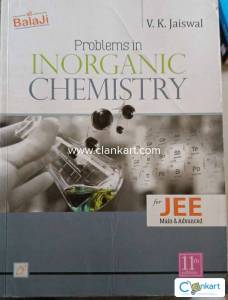
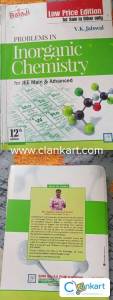
Problems in Inorganic Chemistry by V.K.Jaiswal
These questions are thought-provoking and cover the application of various concepts in solving problems. Questions in this book are handpicked by experienced faculty members of Career Point to enhance the following skills of the students 1. Understanding of concepts and their application to the grass-root level. 2. Improving their scoring ability & accuracy by providing an opportunity to practice a variety of questions. The book approaches the subject in a very conceptual and coherent manner. Chapter-wise varieties of questions are arranged in a sequential manner to build a strong foundation of fundamentals. The coverage and features of books make it highly useful for all those preparing for JEE (Main & Advanced) and aspiring to become IITians or NITians. The book is also useful for students who are preparing for KVPY and Olympiads. The book is also useful for students who are preparing for KVPY and Olympiads. This volume consists of chapter wise challenging questions with detailed explanatory solutions from the following chapters for JEE- 1. Classification & Nomenclature 2. Isomerism 3. General Organic Chemistry 4. Hydrocarbons 5. Aromatic Chemistry 6. Halogen Derivatives 7. Alcohol, Ether & Phenol 8. Carbonyl Compounds 9. Carboxylic Acid & Its Derivatives 10. Nitrogen Compounds, Amines 11. Carbohydrates, Amino Acid, Protein & Polymers