Buy used UPSC Books online in India
Buy Second Hand Books, Used Books Online In India
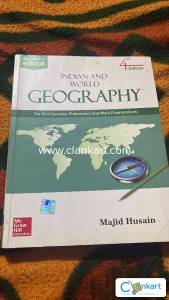
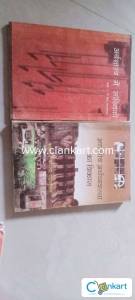
Certificate Physical and Human Geography 2013
This book is a textbook approach that aims at providing an understanding of our planet's physical topography, climatic and vegetative environment, and the relationship that human beings share across regions. The Physical Geography section deals with topics that span the planet's various topographies like the Earth's Crust, Weathering, Mass Movement and Groundwater; Landforms of Glaciation, The Ocean, Lakes, Coastal Landforms, etc. Each chapter has a questions section to help readers evaluate their understanding of the subject explained in that chapter. Various illustrations and photographs enhance the text, to enable all students to easily understand the concepts. Part two of the book, The Weather, Climate and Vegetation section, covers subjects like different climates and climatic zones like Equatorial, Savanna, Tropical or Arctic climates. Table Of Contents PART I PHYSICAL GEOGRAPHY 1. The Earth and the Universe 1 Exploring the Universe 2. The Earth's Crust 3. Vulcanism and Earthquakes 4. Weathering, Mass Movement and Groundwater 5. Landforms made by Running Water 6. Landforms of Glaciation 7. Arid or Desert Landforms 8. Limestone and Chalk Landforms 9. Lakes 66 General, 10. Coastal Landforms 11. Islands and Coral Reefs 12. The Oceans PART 2 WEATHER, CLIMATE AND VEGETATION 13. Weather 14. Climate 15. The Hot, Wet Equatorial Climate 16. The Tropical Monsoon and Tropical Marine Climates 17. The Savanna or Sudan Climate 18. The Hot Desert and Mid-Latitude Desert Cli-mates 19. The Warm Temperate Western Margin (Mediterranean) Climate 20. The Temperate Continental (Steppe) Climate 21. The Warm Temperate Eastern Margin (China Type) Climate 22. The Cool Temperate Western Margin (British Type) Climate 23, The Cool Temperate Continental (Siberian) Climate 24. The Cool Temperate Eastern Margin (Lauren-tian) Climate 25. The Arctic or Polar Climate .
The Pearson Concise General Knowledge Manual 2012
"The Pearson Concise General Knowledge Manual 2012" is a concise compilation of general knowledge questions, based on the study of questions asked in various competitive exams over the past few years. The authors have attempted to keep the facts up to date and accurate. This book is designed to cover the general awareness test section of various competitive exams like the UPSC Civil Services exam, National Defence Academy exam, Indian Forestry Services, Indian Railway Services, and various bank exams. It is structured according to the various subjects of knowledge. The subjects covered are: geography of India, history of India and the freedom struggle, constitution of India, Indian economy, national insignia and other Indian miscellanea, physical and world geography, glimpses of world history, international organizations, everyday science, and computers. Besides these subjects, there are separate chapters on basic general knowledge and current affairs. The twelfth chapter in the book consists of many multiple-choice questions for the readers to gain practice. The book also provides a free supplement, as a companion site to the book, which provides an online testing platform that the readers can use to practice MCQ tests. This can be accessed from computers and GPRS-enabled mobiles.
History of the Modern World by R.V. Rao
This book provides a comprehensive and brilliant introduction to world history. Tracing the origins of the earth and early humans, it discusses the rise and fall of ancient and classical civilisations, the birth of different religions, aspects of medieval society and economy, the age of exploration and the colonisation of Africa, Asia and America. It also covers topics like the two great world wars, the birth of the UN, the process of decolonisation of Asia and Africa, the Cold War and the disintegration of the Soviet Union.
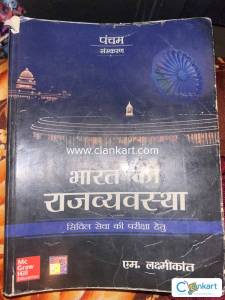
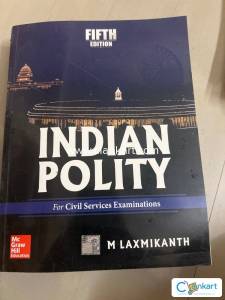
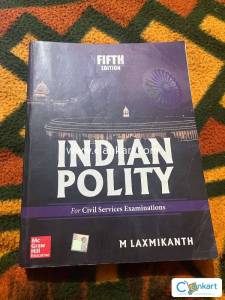
Indian Polity for Civil Services Examinations
Language: EnglishPages: 652PrefaceI am pleased to place before the readers a thoroughly revised, enlarged and updated edition of this widely read book on Indian Polity.In 2011 and 2013, the UPSC changed the pattern and syllabus of the preliminary and main examinations, respectively. In both the changes, the scope of Indian Polity has been considerably increased. Hence, this new edition of the book is more relevant now and is aimed to meet the expanded need of the aspirants. In the course of revision and updation of this edition of the book, the various new developments related to the subject like recent constitutional amendments, parliamentary legislations, executive decisions and supreme court judgments have been taken into account.Changes in this Edition:1. Addition of 8 new chapters.2. Addition of new appendices.3. Inclusion of 2010, 2011, 2012 and 2013 preliminary questions with answers.4. Inclusion of 2009, 2010, 2011 and 2012 mains questions.5. Updation of the year – wise break-up of the UPSC questions in the preliminary and main examinations.6. Inclusion of additional updated information on a number of topics.7. List of Articles included at the end of each chapter.8. New items included in various chapters.New Chapters:1. Basic Structure of the Constitution2. Cabinet Committees3. Parliamentary Committees4. Parliamentary Forums5. Central Bureau of Investigation6. Cooperative Societies7. Special Provisions Relating to Certain Classes8. Electoral ReformsNew Appendices:1. Flag Code of India2. Allied Amending Acts at a Glance3. Model Code of Conduct Relating to ElectionsI firmly believe that is now a
From Government to Governance by kuldeep mathur
An introduction to the concept of governance and the kind of transformation of the state that is taking place in India. It explores the way cooperative networks of state, market and society are taking over roles that were earlier confined to the state alone. This transformation leads to many challenges. Existing institutions of governance have to be so strengthened that they are able to face new demands. New institutions have to be forged that can fulfill the functions of coordination, control and regulation.
Social Problems in India by Ram Ahuja
About the Book: Social Problems In India Social Problems in India has established itself as a leading textbook in the field of sociology. This fully revised, updated and expanded edition distinguishes itself from the previous one as five more chapters on domestic violence, ageing and elder abuse, tribal unrest, globalization and consumerism and agricultural distress and formers suicides. have been added; a few more problems, such as honour killings, acid attack and cyber crimes, have been discussed; data on problems discussed earlier, viz., terrorism, alcoholism, communal violence, drug abuse, child abuse, violence against women, youth unrest, black money, population explosion, juvenile delinquency, unemployment, poverty, urbanization and illiteracy have been updated; and new arguments/comments, reflecting new developments, have been provided. This third edition maintains all the distinctive emphases which gave the earlier two editions nation-wide popularity. It offers analysis and critical evaluation with a sociological perspective and also gives theoretical explanations wherever deemed necessary, increasing the academic importance of the book not only for students and those preparing for the competitive examinations but also for administrators, policy makers, planners and a much wider audience.
Anthropology Simplified by Dr.Vivek Bhasme IAS
A comprehensive text on the theoretical nature of light. Span across wave, electromagnetic and particle nature of light with elaborate explanations. Contents1 View and Vision 1.1 About Camera & Photography 1.2 More about Eye 1.3 What and How we See 2 Light propagation: Catch the Runner 2.1 Refraction:When light reduces its velocity 2.2 Prism & Colour 3 Light as a Wave 3.1 How can we say light is a wave?3.2 Young's Double Slit Experiment3.3 RepresentingLight as a Wave3.4 Young's Double Slit Calculations3.5 Interferometry 3.6 Multiple Beam Interference 3.7 Diffraction 4 Light as Electromagnetic Radiation 4.1 Maxwell'sEquation. 4.2 Maxwell's Equations in Vacuum4.3 Maxwell's Equation in Matter 4.4 Maxwell's Equations to Wave Equation 4.5 Electromagnetic Waves in Space 4.6 Energy of Electromagnetic Wave4.7 Electromagnetic field and Maxwell's Equation4.8 Polarization in Electromagnetic wave4.9 Polarization Affecting Components 4.10Matrix Representation of Polarized Light4.11TE and TM Polarization5 Light As Particles5.1 Light Wave to Light Particle5.2 Photon Statistics.5.3 Electromagnetic Field Quantization5.4 Quantum Optical Representation of Electromagnetic field
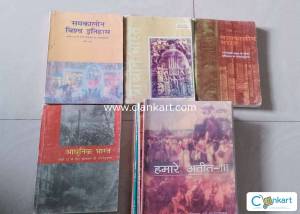
History of modern India by Bipan Chandra for UPSC
Published in the year 2009, History Of Modern India is a book that revolves around the history of British India, throwing light on the nationalist movement and colonialism. History Of Modern India is a book that is written by renowned historian, Bipan Chandra. The contents of this book are a result of Chandra’s research on the subjects of colonialism and nationalism in the country. Apart from his research, Chandra has also drawn from the works of renowned historians during that time in history.In total, there are 14 chapters in this book that cover different periods in Indian history. Some of the chapters in this book include Indian States And Society In The Eighteenth Century, Religious And Social Reform After 1858, The Struggle For Sawaraj, The Nationalist Movement, European Penetration And The British Conquest, Social And Cultural Awakening In The First Half Of The Nineteenth Century, The Decline Of The Mughal Empire, and The Revolt Of 1857. Some other chapters include The Nationalist Movement: 1858-1905, Administrative Changes After 1858, and Administrative Organisation And Society And Cultural Policy.This book doesn’t focus on the political factors during that period, but deals with the economic, religious, and social history of India. Through the course of this book, Chandra provides insight on several events in modern Indian history such as the establishment of the British East India Company, which led to a tightened grip of the British over India. Chandra also explains that the major reason behind the colonial rule was to exploit India by means of investment and trade. The chapters in this book are arranged in chronological order, starting from the British Rule to the independence of the country. This piece of literature provides its readers with loads of information on the nationalist movement, throwing light on the contributions made by several different individuals. This book is a must-have for history students as well as for those who want to gain insight into the history of modern India.