Buy used Politics books online in India
Buy Second Hand Books, Used Books Online In India
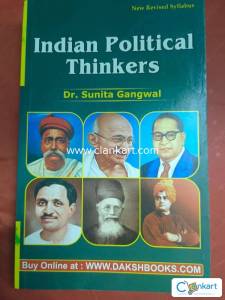
Indian Political Thinkers
Well-maintained copy of Indian Political Thinkers (New Revised Syllabus edition). All pages intact and clean No missing or torn pages No water damage Spine is strong and binding is firm Minor crease marks and slight edge wear on cover due to normal useThe book is in good readable condition and perfect for Political Science students (especially BA / competitive exam preparation).
Political book
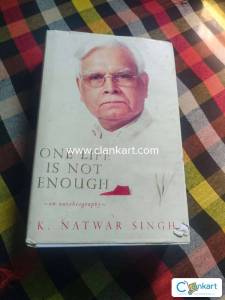
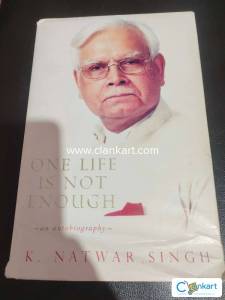
Natwar Singh joined the Indian Foreign Service and served as a bureaucrat for 31 years. He joined the Congress Party in 1984, and became a Minister of State in the then Prime Minister Rajiv Gandhi’s council with the portfolios of steel, agriculture, and coal and mines in 1985. In this much-awaited autobiography, the former cabinet minister talks justly about his experiences and services in various ministries. Singh has played a significant role in Indian politics for more than twenty years and has been a part of some of the most epochal events of independent India, including Indo-China talks and the formation of Bangladesh. In 2002, when the Congress party came back to power, Natwar Singh was appointed as the Minister for External Affairs. But his eventful career saw its end with the Volcker Report in the year 2005. His name appearing in the Iraqi food-for-oil scam forced him to resign from the cabinet and eventually from the Congress party. Singh talks about all these events and the ups and downs of the Congress party in One Life Is Not Enough, an account of an insider. His association with the party allowed him to observe some of the historical events closely, and he talks about Pakistan in the 1980s, under the rule of President Zia-ul-Haq, Indo-Chinese and Indo-USSR relations among other sensitive developments.
Arvind kejriwal biography
The meteoric rise of the Aam Aadmi Party—from inception to running the state of Delhi in thirteen months—is a story with three principal strands. First, Arvind Kejriwal; iconoclast, leader, and disrupter par excellence, who has dared to defy the fundamental templates of Indian politics and governance. Second, the coalescing of a group of unprecedented diversity—a journalist, a lawyer, an academic, a policymaker, a CEO, a retired NSG commando, an architect, and a poet, among many others—on the streets of New Delhi, all bound together by a shared idea of an India that could have been. And, third, of the awakening of the aam aadmi, and of his realization that he can be as active a participant and change-maker in national politics as any other.In The Disrupter, Gautam Chikermane and Soma Banerjee provide an in-depth, fly-on-the-wall account of how these three strands came together to create a brand-new political tapestry. And how a single political party shattered the status quo; captivated the imagination of the citizenry, taking people beyond the usual cynical labels of caste and creed; and changed the contemporary political narrative in ways that are both unthinkable and unpredictable.
Indian Politics
Hardcover Book - India's quest to ascend the global hierarchy isv an endless journey. But as we take stockof the progress made and anticipate the chellanges ahead , it is certainly reassuring that this is propelled by such deep national commitment and confidence .....
a nation of idiots
DO NOT BUY THIS BOOK IF YOU ARE EASILY OFFENDEDInspired by true stories, Daksh Tyagi's witty and hugely entertaining book 'An Indian citizen's guide on how to avoid A Nation of Idiots' takes on the uncomfortable, the unsettling, and the often misunderstood modern Indian life.WE INDIANS ARE AN INTERESTING BUNCH.Intolerant to the debate on intolerance, but tolerant of religious intolerance. We cling onto age-old traditions, but a holiday can alter our accent. To us, caste and community is a badge of trust, religion is a line of control and a godman is an anti-depressant.We won’t stop at a zebra crossing, but we will damn well stop on it. We build things to prove our worth and break things to prove a point. We love the concept of independence, but we need our parents to help raise our kids. And we scripted the Kamasutra. Easy to forget, since we also ruined sex.So how do we tell the real from the farcical? The farcical from the nutty? And the nutty from the downright ridiculous?Easy. We just go along.Daksh Tyagi's funny and insightful 'A Nation of Idiots' is the ideal guide to surviving the modern Indian life with your scruples intact.
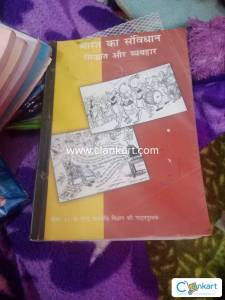
Textbook for political science first semester ug
Examines a fairly wide range of issues concerning the ever-expanding field of political theory, in a multidisciplinary (historical-sociological-economic-philosophical-juristic) perspective. It elaborates the nature and significance of political theory, concept of ideology with a concise and critical discussion of major political ideologies, nature of politics and various approaches to its study including empirical, normative, behavioural, post-behavioural as well as interdisciplinary approach. It elucidates the concepts of the state and sovereignty with reference to the challenges of imperialism, colonialism, neo-colonialism, impact of globalization, grounds and limits of political obligation, various dimensions of law (including rule of law), power (along with authority and legitimacy) citizenship (including democratic citizenship), human rights, liberty (including freedom as emancipation), equality (including equality of opportunity), justice (including social justice) and the common good. Then it dwells on various models and theories of democracy (including participatory and deliberative democracy), indicating the significance of multiculturalism. Finally it gives a critical account of the theories of social change and development with special reference to the problems of underdevelopment, sustainable development and political development
International relations today
"International Relations Today ...", 2nd Edition, captures the drastic changes that the discipline of IR has undergone since the disintegration of the Soviet Union and the end of the Cold War in 1991. Other than covering changes in the post - Cold War world order, the book also focusses on emerging issues in interational relations such as environment, terrorism, food security and globalization. Two important theories in IR, namely the ‘English School’ and ‘Critical Theory’ have been added to the existing 11 theories in Chapter 2, which analyses major theories in the discipline of IR. Foreign policies of major powers in the world today, namely, the U.S., China, Russia, Japan, Britain and India have been updated till the year 2018, to make these contemporary and relevant. For instance, foreign policy of India has been updated to cover the premiership of Narendra Modi. Similarly, U.S. foreign policy analysis covered the presidency of Donald Trump, and Russian foreign policy discourse looked at the Putin years. Likewise, Chapters on the U.N.; Nuclear and Security Issues; Regional Organizations; ‘Other Inter Governmental Organizations’; Post Cold War International Relations; International Political Economy and Recent Issues in IR have been upgraded to cover recent periods and events
The india way
The decade from the 2008 global financial crisis to the 2020 coronavirus pandemic has seen a real transformation of the world order. The very nature of international relations and its rules are changing before our eyes.For India, this means optimal relationships with all the major powers to best advance its goals. It also requires a bolder and non-reciprocal approach to its neighbourhood. A global footprint is now in the making that leverages India’s greater capability and relevance, as well as its unique diaspora. This era of global upheaval entails greater expectations from India, putting it on the path to becoming a leading power.In The India Way, S. Jaishankar, India’s Minister of External Affairs, analyses these challenges and spells out possible policy responses. He places this thinking in the context of history and tradition, appropriate for a civilizational power that seeks to reclaim its place on the world stage.
The Verdict
What are the key factors that win or lose elections in India? What does, or does not, make India's democracy tick? Is this the end of anti-incumbency? Are opinion polls and exit polls reliable? How pervasive is the 'fear factor'? Does the Indian woman's vote matter? Does the selection of candidates impact results? Are elections becoming more democratic or less so? Can electronic voting machines (EVMs) be fiddled with? Can Indian elections be called 'a jugaad system'? Published on the eve of India's next general elections, The Verdict will use rigorous psephology, original research and as-yet-undisclosed facts to talk about the entire span of India's electoral history from the first elections in 1952. Crucially, for 2019, it provides pointers to look out for, to see if the incumbent government will win or lose. Written by Prannoy Roy, renowned for his knack of demystifying electoral politics, and Dorab R. Sopariwala, this book will be compulsory reading for anyone interested in politics and elections in India.