Clankart Logo

Buy used Master of Computer Applications (MCA) books online in India

Buy Second Hand Books, Used Books Online In India

Advertisement
learn python

learn python

₹599 ₹680
12% off

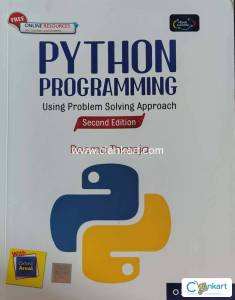
Learn Python Quickly, A Programmer-Friendly Guide DESCRIPTION Most ProgrammerÕs learning Python are usually comfortable with some or the other programming language and are not interested in going through the typical learning curve of learning the first programming language. Instead, they are looking for something that can get them off the ground quickly. They are looking for similarities and differences in a feature that they have used in other language(s). This book should help them immediately. It guides you from the fundamentals of using module through the use of advanced object orientation. KEY FEATURES Strengthens the foundations, as detailed explanation of programming language concepts are given in simple manner.Ê Lists down all the important points that you need to know related to various topics in an organized manner. Prepares you for coding related interview and theoretical questions. Provides In depth explanation of complex topics and Questions. Focuses on how to think logically to solve a problem. Follows a systematic approach that will help you to prepare for an interview in short duration of time. Exercises are exceptionally useful to complete the readerÕs understanding of a topic. Ê WHAT WILL YOU LEARN Data types, Control flow instructions, consoleÊ& File Input/Output Strings, list & tuples, List comprehension Sets & Dictionaries, Functions & Lambdas Dictionary Comprehension Modules, classes and objects, Inheritance Operator overloading, Exception handling Iterators & Generators, Decorators, Command-line Parsing Ê WHO THIS BOOK IS FOR Students, Programmers, researchers, and software developers who wish to learn the basics of Python programming language. Ê Table of ContentsÊ 1. Introduction to Python 2. Python BasicsÊÊÊÊ 3. Strings 4. Decision Control Instruction 5. Repetition Control Instruction 6. Console Input/Output 7. Lists 8. Tuples 9. Sets 10. Dictionaries 11. Comprehensions 12. Functions 13. Recursion 14. Functional Programming 15. Modules and Packages 16. Namespaces 17. Classes and Objects 1

1 month ago
Want to see your books here? Have Used Books?
Make some extra cash by selling your old books for actual money in your UPI/Bank account. Go on, it's quick and easy.

Advertisement
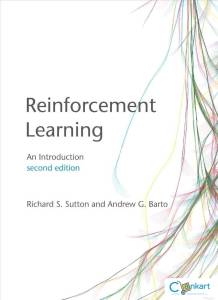
Reinforcement Learning, second edition: An Introduction Hardcover

Reinforcement Learning, second edition: An Introduction Hardcover

₹2850

The significantly expanded and updated new edition of a widely used text on reinforcement learning, one of the most active research areas in artificial intelligence.Reinforcement learning, one of the most active research areas in artificial intelligence, is a computational approach to learning whereby an agent tries to maximize the total amount of reward it receives while interacting with a complex, uncertain environment. In Reinforcement Learning, Richard Sutton and Andrew Barto provide a clear and simple account of the field's key ideas and algorithms. This second edition has been significantly expanded and updated, presenting new topics and updating coverage of other topics.Like the first edition, this second edition focuses on core online learning algorithms, with the more mathematical material set off in shaded boxes. Part I covers as much of reinforcement learning as possible without going beyond the tabular case for which exact solutions can be found. Many algorithms presented in this part are new to the second edition, including UCB, Expected Sarsa, and Double Learning. Part II extends these ideas to function approximation, with new sections on such topics as artificial neural networks and the Fourier basis, and offers expanded treatment of off-policy learning and policy-gradient methods. Part III has new chapters on reinforcement learning's relationships to psychology and neuroscience, as well as an updated case-studies chapter including AlphaGo and AlphaGo Zero, Atari game playing, and IBM Watson's wagering strategy. The final chapter discusses the future societal impacts of reinforcement learning.

2 months ago
Advertisement
The Future of Artificial Intelligence: Computational Intelligence

The Future of Artificial Intelligence: Computational Intelligence

₹599 ₹1000
40% off

The Future of Artificial Intelligence: Computational Intelligence, Ethical Frameworks, and Societal Impact presents a comprehensive and interdisciplinary examination of artificial intelligence as both a technological advancement and a transformative force shaping contemporary society. As AI systems increasingly influence decision-making, governance, economic structures, and human interaction, the need for a balanced understanding that integrates technical foundations with ethical and social considerations has become essential. This book addresses that need by offering a holistic perspective on how artificial intelligence is developed, applied, and governed in real-world contexts.The book explores artificial intelligence from its conceptual roots to its modern implementations, emphasizing how intelligent behavior emerges from computational intelligence, adaptive learning, and data-driven systems. It examines the mechanisms through which machines learn, reason under uncertainty, and support complex decision-making processes. By focusing on machine learning, deep learning, and bio inspired computational models, the book explains how AI systems achieve performance, adaptability, and scalability across diverse domains.Beyond technical foundations, the book critically engages with the ethical dimensions of artificial intelligence. It highlights key concerns related to transparency, explainability, accountability, fairness, and human autonomy. Rather than treating ethics as an external constraint, the book integrates ethical reasoning into the discussion of AI design and deployment, emphasizing that responsible innovation is central to sustainable technological progress. Ethical frameworks are presented as practical tools for guiding decisions in environments where AI systems have significant social impact.A central theme of the book is the relationship between artificial intelligence and society. It examines how AI reshapes work, education, healthcare, public services, and cultural practices, while also addressing challenges such as inequality, digital divides, and access to technology. The book emphasizes that AI is not a neutral force but a socio-technical system shaped by human choices, institutional structures, and cultural values. Understanding this relationship is essential for ensuring that AI contributes to inclusive and equitable social development.The book also addresses the policy and governance challenges associated with the global expansion of artificial intelligence. It considers the need for legal accountability, regulatory balance, and international cooperation in managing AI technologies that operate across borders. By examining governance from both national and global perspectives, the book highlights the importance of aligning innovation with public trust and societal responsibility. Looking toward the future, the book explores emerging trends in artificial intelligence, including increasing autonomy, human-centered and collaborative systems, and the convergence of AI with other advanced technologies. It emphasizes ethical foresight and longterm thinking as essential components of guiding AI development in ways that support human dignity, environmental sustainability, and social resilience. Written in a clear and scholarly style, this book is intended for researchers, students, educators, policymakers, and practitioners seeking a deep and reflective understanding of artificial intelligence.The Future of Artificial Intelligence offers not only technical insight but also ethical and societal guidance, positioning AI as a tool that must be shaped deliberately and responsibly to serve human and collective well-being in an increasingly automated world.

6 months ago
Microservices Design Patterns in .Net

Microservices Design Patterns in .Net

₹2000

Learn to be deliberate and intentional in your design, technology, and pattern choices when developing an application using a microservices architecture. Key Features Tackle common design problems when developing a microservices application using .NET Core Explore applying S.O.L.I.D development principles in developing a stable microservice application Use your knowledge to solve common microservice application design challenges Book DescriptionAre you a developer who needs to fully understand the different patterns and benefits that they bring to designing microservices? If yes, then this book is for you. Microservices Design Patterns in .NET will help you appreciate the various microservice design concerns and strategies that can be used to navigate them. Making a microservice-based app is no easy feat and there are many concerns that need to be addressed. As you progress through the chapters of this guide, you’ll dive headfirst into the problems that come packed with this architectural approach, and then explore the design patterns that address these problems. You’ll also learn how to be deliberate and intentional in your architectural design to overcome major considerations in building microservices. By the end of this book, you’ll be able to apply critical thinking and clean coding principles when creating a microservices application using .NET Core.What you will learn Use Domain-Driven Design principles in your microservice design Leverage patterns like event sourcing, database-per-service, and asynchronous communication Build resilient web services and mitigate failures and outages Ensure data consistency in distributed systems Leverage industry standard technology to design a robust distributed application Find out how to secure a microservices-designed application Use containers to handle lightweight microservice application deployment Who this book is for If you are a .NET developer, senior developer, software architect, or DevOps engineer who wants to explore the pros and cons, intricacies, and overall

6 months ago
Advertisement
Advertisement