Buy used Business & Economics books online in India
Buy Second Hand Books, Used Books Online In India
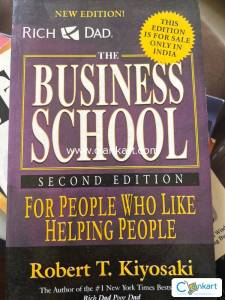
The Business School
The book describes what the real values of network marketing business are. It is more than just making money. He says that it is a business having a heart. Rich Dad’s The Business School does not promote any specific network marketing organization, but aims to educate the reader on how to select one.
COPYCAT MARKETING 101
About 95 percent of workers in industrialized countries are employees, make less than $40,000 per year, and save about $2,000 per year. At first glance, these figures may look pretty impressive, especially to people who make less than $40,000. But the truth is, 95 percent of the people in this world aren't getting ahead they're just getting by.Just look at the financial condition of the "average" U.S. citizen at age 65: 36 percent are dead, 54 percent are broke or dependent on others, 5 percent are still working, 4 percent are financially independent, and 1 percent are wealthy. Only 5 percent are financially well off!If you had the opportunity to become a 5%-er, would you take advantage of it? If your answer is "yes," read on, because that's what this book is about.Copycat Marketing 101 will make you aware that most people are 95%-ers because they've been taught to copy people who are in jobs that mean salary caps and financial dependence. In short, most people are copycatting the wrong plan!In this book, you'll learn that the current system most people copycat is designed to create temporary income not true wealth because it's based on linear growth of trading time for dollars. You'll learn that the key to true wealth is leverage, and you will learn about a dynamic form of leverage that wealthy people have been copying for centuries called exponential growth.Best of all, you'll learn how average people can break out of the time-for-money trap by copycatting a simple, duplicatable system of wealth creation that will open the door to financial freedom, once and for all!
Guiding book for aspiring business starters!
Are you finding it tough to fund y our start-up? Especially in the post-COVID-19 world, where money is scarce? Well, then, this book is for you. It takes you through stories of early-stage start-ups and how they successfully managed to raise funding. Even better, it takes you through stories of failures-start-ups that couldn't raise funding, and why. After all, you can learn as much from failures as you can from successes. The authors also inter view some of the most accomplished founders in the world of business, such as Deep Kalra of MakeMyTrip, Yashish Dahiya of PolicyBazaar, Dinesh Agarwal of IndiaMART and Sairee Chahal of SHEROES. Their stories all come together in a useful 'PERSISTENT' framework, which helps make a start-up investment-ready.
Factfulness
Factfulness: The stress-reducing habit of only carrying opinions for which you have strong supporting facts.When asked simple questions about global trends—what percentage of the world’s population live in poverty; why the world’s population is increasing; how many girls finish school—we systematically get the answers wrong. So wrong that a chimpanzee choosing answers at random will consistently outguess teachers, journalists, Nobel laureates, and investment bankers.In Factfulness, Professor of International Health and global TED phenomenon Hans Rosling, together with his two long-time collaborators, Anna and Ola, offers a radical new explanation of why this happens. They reveal the ten instincts that distort our perspective—from our tendency to divide the world into two camps (usually some version of us and them) to the way we consume media (where fear rules) to how we perceive progress (believing that most things are getting worse).Our problem is that we don’t know what we don’t know, and even our guesses are informed by unconscious and predictable biases.It turns out that the world, for all its imperfections, is in a much better state than we might think. That doesn’t mean there aren’t real concerns. But when we worry about everything all the time instead of embracing a worldview based on facts, we can lose our ability to focus on the things that threaten us most.Inspiring and revelatory, filled with lively anecdotes and moving stories, Factfulness is an urgent and essential book that will change the way you see the world and empower you to respond to the crises and opportunities of the future.
Rich Dad Poor Dad
April 2017 marks 20 years since Robert Kiyosaki’s Rich Dad Poor Dad first made waves in the Personal Finance arena.It has since become the #1 Personal Finance book of all time... translated into dozens of languages and sold around the world.Rich Dad Poor Dad is Robert's story of growing up with two dads — his real father and the father of his best friend, his rich dad — and the ways in which both men shaped his thoughts about money and investing. The book explodes the myth that you need to earn a high income to be rich and explains the difference between working for money and having your money work for you.20 Years... 20/20 HindsightIn the 20th Anniversary Edition of this classic, Robert offers an update on what we’ve seen over the past 20 years related to money, investing, and the global economy. Sidebars throughout the book will take readers “fast forward” — from 1997 to today — as Robert assesses how the principles taught by his rich dad have stood the test of time.In many ways, the messages of Rich Dad Poor Dad, messages that were criticized and challenged two decades ago, are more meaningful, relevant and important today than they were 20 years ago.As always, readers can expect that Robert will be candid, insightful... and continue to rock more than a few boats in his retrospective.Will there be a few surprises? Count on it.Rich Dad Poor Dad...• Explodes the myth that you need to earn a high income to become rich• Challenges the belief that your house is an asset• Shows parents why they can't rely on the school system to teach their kids about money• Defines once and for all an asset and a liability• Teaches you what to teach your kids about money for their future financial success
THE WEALTH OF NATIONS
Adam Smith's masterpiece, first published in 1776, is the foundation of modern economic thought and remains the single most important account of the rise of, and the principles behind, modern capitalism. Written in clear and incisive prose, The Wealth of Nations articulates the concepts indispensable to an understanding of contemporary society; and Robert Reich's Introduction both clarifies Smith's analyses and illuminates his overall relevance to the world in which we live. As Reich writes, "Smith's mind ranged over issues as fresh and topical today as they were in the late eighteenth century--jobs, wages, politics, government, trade, education, business, and ethics."Introduction by Robert Reich - Commentary by R. H. Campbell and A. S. Skinner - Includes a Modern Library Reading Group Guide
Macroeconomic class 12
Restructured and revised in sync with the revised syllabus & updated guidelines by the CBSE board. A gist of major modifications: Brain Teaser blocks to test logical clarity and implication based learning. Test Your Understanding blocks to promote application, analysis & evaluation of concepts. Basic Numericals following hand-holding approach for budding economists. Categorisation & sub-classification of numericals for easy identification of nature of problem. HOTS: Each chapter is splashed with HOTS to promote clarity of the basics and provide some food for thought to the avid readers. ‘Did You Know’ blocks are provided in each chapter to highlight the significance of core concepts. Wide variety of questions: A wide variety of questions patterned along the CBSE released Sample Question Paper (2023) have been incorporated in each Chapter. The category of questions incorporated are: Competency-Based Learning: Objective Questions: Multiple Choice Questions Fill in the Blanks True-False alternatives Choose the Correct Pair of Statements/Identify the Correct Sequence of Alternatives One Liners: Answer with Reason Competency Based Learning: Data/Picture Based & Case-Study Based Questions Data/Picture Based Questions, Case-Study Based Questions Competency Based Learning: Descriptive Questions: Very Short Answer Type Questions HOTS & applications Analysis & Evaluation NCERT questions (with hints to answers) Miscellaneous Questions and Reference to the Text for Answers Solved Numericals Unsolved Numericals We have also added sample projects patterned along the latest CBSE format for the reference of the students. Sample Paper by “VK Global Study Group” based on the specimen paper woven along the same structure and blueprint as suggested in the CBSE released Sample Question Paper-2023 has been included. Harmony and Synchronisation: To maintain clarity of thought; the information in our book has been compiled and presented in a step by step manner so that students are able to comprehend things better. Comprehensive and elu
HOW TO CHANGE THE WORLD
Now published in more than twenty countries, David Bornstein's How to Change the World has become the bible for social entrepreneurship--in which men and women around the world are finding innovative solutions to a wide variety of social and economic problems. Whether delivering solar energy to Braz ... Available here:readbux.com/download?i=B003U2T7JAHow to Change the World: Social Entrepreneurs and the Power of New Ideas, Updated Edition PDF by David BornsteinRead How to Change the World: Social Entrepreneurs and the Power of New Ideas, Updated Edition PDF from Oxford University Press,David BornsteinDownload David Bornstein’s PDF E-book How to Change the World: Social Entrepreneurs and the Power of New Ideas, Updated Edition
Getting things done
With first-chapter allusions to martial arts, "flow," "mind like water," and other concepts borrowed from the East (and usually mangled), you'd almost think this self-helper from David Allen should have been called Zen and the Art of Schedule Maintenance. Not quite. Yes, Getting Things Done offers a complete system for downloading all those free-floating gotta-do's clogging your brain into a sophisticated framework of files and action lists--all purportedly to free your mind to focus on whatever you're working on. However, it still operates from the decidedly Western notion that if we could just get really, really organized, we could turn ourselves into 24/7 productivity machines. (To wit, Allen, whom the New Economy bible Fast Company has dubbed "the personal productivity guru," suggests that instead of meditating on crouching tigers and hidden dragons while you wait for a plane, you should unsheathe that high-tech saber known as the cell phone and attack that list of calls you need to return.) As whole-life-organizing systems go, Allen's is pretty good, even fun and therapeutic. It starts with the exhortation to take every unaccounted-for scrap of paper in your workstation that you can't junk, The next step is to write down every unaccounted-for gotta-do cramming your head onto its own scrap of paper. Finally, throw the whole stew into a giant "in-basket" That's where the processing and prioritizing begin; in Allen's system, it get a little convoluted at times, rife as it is with fancy terms, subterms, and sub-subterms for even the simplest concepts. Thank goodness the spine of his system is captured on a straightforward, one-page flowchart that you can pin over your desk and repeatedly consult without having to refer back to the book. That alone is worth the purchase price. Also of value is Allen's ingenious Two-Minute Rule: if there's anything you absolutely must do that you can do right now in two minutes or less, then do it now, thus freeing up your time and mind tenfold over the long term. It's commonsens
Warren buffett and the interpretation of Financial statements.
Inspirándose en en la obra fundamental de Benjamin Graham, mentor de Buffett, The interpretation of financial statements (1937), los autores nos aproximan a una de las claves del éxito del oráculo de Omaha: su interpretación de los estados financieros de las empresas en las que pretende invertir.A través de la perspectiva única y privilegiada de Mary Buffett y David Clark, el lector conocerá de primera mano la aproximación y lectura que hace Buffett de los estados financieros, buscando siempre empresas con una ventaja competitiva duradera que le brinde réditos sostenidos durante un largo periodo de tiempo. Huyendo, asimismo, de movimientos especulativos y estrategias ávidas de ganancias rápidas.Warren Buffett y la interpretación de estados financieros, permitirá al lector saber qué nivel de deuda es asumible por una empresa, cuál es el coste y beneficio de los departamentos de Investigación y desarrollo, cómo valorar el balance general de las empresas y su margen de beneficio o reconocer la importancia de su pasivo. Un libro útil, claro y accesible para todo aquel que busque emular los métodos del inversor más reconocido del mundo.
VK Ohri statistics for economics class 11
The CBSE board has recently shown a bent towards analysis and interpretation based questions under the label of ‘competency- based questions’. This book is prepared according to revised syllabus and new paper pattern. ‘The Same but Different’: Revised and restructured on positive feedback, the Statistics for Economics Textbook is all geared up to provide its readers step by step comprehension of the subject matter. Novelties of the text include: 1. NEW TYPOLOGY OF QUESTIONS: (Image/Data interpretation, defend and refute type questions etc.) have been incorporated in each chapter. 2. ‘BRAIN TEASER’ BLOCKS: Implication based questions related to current happenings around have been incorporated in each chapter. These help gauge the inferences the students are able to draw from the text and how easily they are able to relate economic theory to the ground level realities. 3. OTHERS: HOTS & Focus Zones DAV Board Question Paper (Solved) Sample Paper By “VK Global Study Group”[A specimen paper woven along the same structure and blueprint as suggested in the CBSE released Sample Question Paper-2023.]
Quantitative Techniques for Managerial Decisions, 2nd Edition Print
This book is specially designed for a course in Quantitative Techniques taught to MBA students. It provides the students with a thorough introduction to basic quantitative tools required to perform analytical evaluations and arrive at logical decisions. The second edition of the book essentially retains the flavour of the first edition. Concepts have been explained in an easy to understand language and emphasis is on practical applications rather than rigorous mathematical treatment. As far as possible, detailed proofs and axioms associated with pure mathematics have been avoided. The text in the second edition has been suitably modified for giving better clarity. Nearly fifty solved examples have been added to various chapters to enable students to understand the nuances of problem solving. Fifty unsolved problems have also been added to give ample scope to the student for practice. The book also includes chapters on transportation models, assignment models and network analysis. KEY FEATURES : Learning objectives at the beginning of each chapter enable students to focus on important points of a chapter. Case studies and real life problems to connect students to the real-world situations. Worked examples to enhance student comprehension of the subject. Numerous well-balanced chapter-end exercises with answers to help students attain confidence and master the concepts. Illustrations on solutions to problems with the help of computer software. Summary at the end of each chapter to help students review the key concepts.
The 7 habits of highly effective people
In The 7 Habits of Highly Effective People, author Stephen R. Covey presents a holistic, integrated, principle-centered approach for solving personal and professional problems. With penetrating insights and pointed anecdotes, Covey reveals a step-by-step pathway for living with fairness, integrity, service, and human dignity -- principles that give us the security to adapt to change and the wisdom and power to take advantage of the opportunities that change creates.
SELF DEVELOPMENT BOOK
More than 6 million readers around the world have improved their lives by reading The Magic of Thinking Big. First published in 1959, David J Schwartz's classic teachings are as powerful today as they were then. Practical, empowering and hugely engaging, this book will not only inspire you, it will give you the tools to change your life for the better - starting from now. His step-by-step approach will show you how to:- Defeat disbelief and the negative power it creates- Make your mind produce positive thoughts- Plan a concrete success-building programme- Do more and do it better by turning on your creative power- Capitalise on the power of NOWUpdated for the 21st century, this is your go-to guide to a better life, starting with the way you think.
BUSINESS ECONOMICS
The book provides conceptual understanding of essential concepts in business life. It details the foundations of business economics with special emphasis on demand analysis and consumer behaviour. It also discusses analysis of production and cost of the firm, market structures and pricing of products, factor pricing and income distribution and concludes with the discussion of capital budgeting. Based on the author's extensive teaching experience, the book champions a collaborative approach to delivering an appropriate textbook that is curriculum relevant.
Discover the mindset for achieving success
Now updated with new research — the book that has changed millions of lives.After decades of research, world-renowned Stanford University psychologist Carol S. Dweck, Ph.D., discovered a simple but groundbreaking idea: the power of mindset. In this brilliant book, she shows how success in school, work, sports, the arts, and almost every area of human endeavor can be dramatically influenced by how we think about our talents and abilities. People with a fixed mindset — those who believe that abilities are fixed — are less likely to flourish than those with a growth mindset — those who believe that abilities can be developed. Mindset reveals how great parents, teachers, managers, and athletes can put this idea to use to foster outstanding accomplishment.In this edition, Dweck offers new insights into her now famous and broadly embraced concept. She introduces a phenomenon she calls false growth mindset and guides people toward adopting a deeper, truer growth mindset. She also expands the mindset concept beyond the individual, applying it to the cultures of groups and organizations. With the right mindset, you can motivate those you lead, teach, and love — to transform their lives and your own.